Support Synonyms: 18 Other Ways to Say Support (With Examples & Usage Tips)
⏱ ≈ 6 min read
🔄 Updated Oct 2026

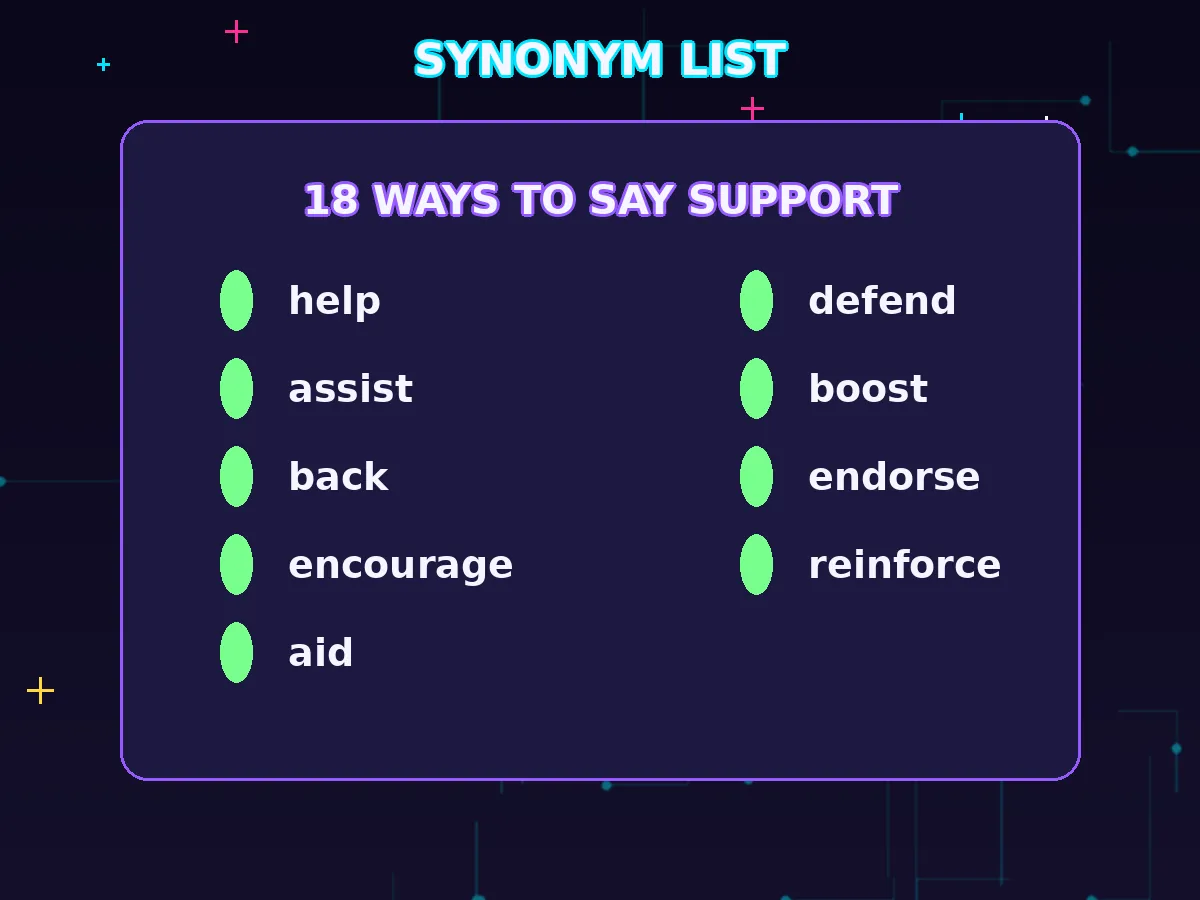
18 Other Ways to Say Support
We say “support” in almost every area of life — friendships, work, charity, sports — so repeating it gets dull fast. These 18 support synonyms cover every shade, from a helping hand to public endorsement, each with its meaning, usage guidance, and three original example sentences. Brush up on the basics in Wikipedia’s guide to synonyms, and discover more word power at SpellDict.
1. Help
Meaning: To give assistance or make something easier for someone.
When to use: Almost any everyday situation — the friendliest, simplest choice.
When to avoid: Very formal documents, where “assist” or “aid” sounds more professional.
- Can you help me carry these boxes upstairs?
- She stayed late to help her colleague finish the report.
- Volunteers help hundreds of families every winter.
2. Assist
Meaning: To help in a professional or structured way, often as part of a team.
When to use: Workplaces, hospitals, customer service, and formal requests.
When to avoid: Intimate emotional moments — “assist” sounds clinical for comforting a friend.
- The nurse will assist the surgeon during the operation.
- Our team assists clients with setting up their accounts.
- He assisted the elderly man across the busy street.
3. Back
Meaning: To stand behind someone with loyalty, agreement, or resources.
When to use: Showing loyalty to friends, ideas, or projects.
When to avoid: Physical assistance — “back” is about loyalty, not lifting.
- I will back your decision whatever you choose.
- The investors backed the young founder’s vision.
- She always backs her friends when they need courage.
4. Encourage
Meaning: To give someone confidence and motivation to keep going.
When to use: Teaching, coaching, parenting, or cheering someone through doubt.
When to avoid: Situations needing practical help — encouragement alone won’t fix a flat tire.
- Teachers encourage students to ask bold questions.
- He encouraged his sister to apply for the scholarship.
- The coach’s words encouraged the team before the final.
5. Aid
Meaning: Practical or emergency assistance, often in serious or humanitarian contexts.
When to use: Disaster relief, medical help, or formal aid programs.
When to avoid: Light everyday favors — “aid” sounds too grave for borrowing sugar.
- Rescue teams rushed aid to the earthquake zone.
- The charity provides food aid to remote villages.
- She aided her neighbor after the storm damaged his roof.
6. Stand By
Meaning: To remain loyal and present for someone through good and bad times.
When to use: Friendships, family, and long-term loyalty.
When to avoid: One-off practical tasks — standing by is about loyalty, not errands.
- True friends stand by you when life gets hard.
- She stood by her brother throughout the long trial.
- The fans stood by the team even after relegation.
7. Uphold
Meaning: To maintain or defend a principle, rule, or decision.
When to use: Legal, academic, and ethical contexts.
When to avoid: Emotional or personal support — it is about principles, not people.
- The court upheld the earlier ruling on appeal.
- We must uphold the values this school stands for.
- She upholds the highest standards in her research.
8. Sponsor
Meaning: To support financially or publicly, providing money or resources.
When to use: Business, sports, charity events, and education.
When to avoid: Emotional support — sponsoring is financial or promotional.
- The local bakery sponsors the youth football team.
- Her company sponsored my master’s degree.
- They sponsored a beach cleanup this weekend.
9. Defend
Meaning: To protect someone or something from criticism, harm, or attack.
When to use: Loyalty under fire — arguments, courtrooms, or unfair blame.
When to avoid: Neutral situations with no threat — defending implies opposition.
- He defended his friend’s reputation fiercely.
- The lawyer defended her client with brilliant arguments.
- She defended the new policy at the town meeting.
10. Boost
Meaning: To increase, lift, or improve someone’s confidence, energy, or progress.
When to use: Motivation, marketing, morale, and performance.
When to avoid: Deep emotional crises — a boost is uplifting, not healing.
- A morning walk boosts my focus for the whole day.
- Her compliment boosted his confidence before the interview.
- The new ad campaign boosted sales by thirty percent.
11. Promote
Meaning: To actively advance or recommend someone, something, or a cause.
When to use: Careers, marketing, health campaigns, and social causes.
When to avoid: Private emotional support — promoting is public and active.
- The manager promoted her star employee to team lead.
- Schools promote healthy eating through fun programs.
- He promoted his friend’s novel on every podcast he joined.
12. Endorse
Meaning: To publicly approve or recommend a person, product, or idea.
When to use: Politics, advertising, reviews, and public recommendations.
When to avoid: Private help — endorsing is a public act.
- The famous chef endorsed the new cookware line.
- She endorsed the charity’s fundraising campaign.
- Two senators endorsed the education reform bill.
13. Strengthen
Meaning: To make support, relationships, or structures stronger and more reliable.
When to use: Team building, relationships, skills, and systems.
When to avoid: One-time acts — strengthening is a gradual process.
- Weekly meetings strengthened trust across the team.
- Regular practice strengthens both body and mind.
- The new laws strengthened protections for tenants.
14. Comfort
Meaning: To ease someone’s sadness, fear, or pain with kindness and presence.
When to use: Grief, anxiety, illness, and emotional distress.
When to avoid: Practical or financial problems — comfort soothes feelings, not budgets.
- She comforted her crying daughter after the bad dream.
- A warm meal can comfort a weary traveler.
- His calm voice comforted the nervous passengers.
15. Cheer
Meaning: To support loudly and enthusiastically, often with applause or shouts.
When to use: Sports, performances, competitions, and celebrations.
When to avoid: Quiet or somber occasions — cheering would be inappropriate.
- The crowd cheered as the runners crossed the finish line.
- We cheered our loudest during the school play.
- Her friends cheered when she got the job offer.
16. Prop Up
Meaning: To hold something or someone steady that might otherwise fall or fail.
When to use: Struggling projects, wobbly furniture, or fragile situations.
When to avoid: Formal writing — it is a casual, visual metaphor.
- Emergency funding propped up the small clinic.
- He propped up the old fence with wooden beams.
- Her encouragement propped up his confidence all semester.
17. Reinforce
Meaning: To strengthen existing support with extra help, resources, or emphasis.
When to use: Learning, safety, teamwork, and habits.
When to avoid: Brand-new situations — reinforcing builds on what already exists.
- Daily quizzes reinforce the students’ vocabulary.
- The coach reinforced the basics before the big game.
- New guardrails reinforced safety on the mountain road.
18. Maintain
Meaning: To keep support going steadily over a long time.
When to use: Ongoing relationships, standards, and long-term commitments.
When to avoid: Brand-new situations — reinforcing builds on what already exists.
- She maintains close friendships despite living abroad.
- The clinic maintains free checkups for seniors.
- He maintains a calm routine to manage his stress.
Supporting others often means making their load lighter — see our easy synonyms and better synonyms guides for related words.
Formal vs. Casual: Choosing the Right Support Synonym
The right word changes with the setting. Compare how each synonym behaves in formal and casual contexts:
| Synonym | Formal Example | Casual Example |
|---|---|---|
| Assist | Our staff will assist you with the application. | Can you assist me with this heavy bag? |
| Aid | The fund provides aid to disaster victims. | Neighbors aided each other after the storm. |
| Endorse | The committee endorsed the new policy. | I totally endorse this pizza place. |
| Uphold | Judges must uphold the constitution. | We should uphold our family traditions. |
| Back | The board backed the merger proposal. | I’ve got your back, don’t worry. |
| Prop up | Subsidies propped up the struggling sector. | Coffee propped me up through finals. |
| Cheer | The audience cheered the keynote speaker. | We cheered so loud at the match! |
| Boost | The initiative boosted regional employment. | This song always boosts my mood. |
| Comfort | Counselors comfort grieving families. | She comforted me after the bad news. |
| Help | The program helps refugees find work. | Help me out with the dishes, please. |

Common Mistakes When Using Support Synonyms
1. Using “sponsor” for emotional support. Sponsoring means money or public backing — “she sponsored me through my grief” is wrong. Say “she comforted me” or “she stood by me” instead.
2. Swapping “assist” and “comfort.” “Assist” is practical and professional; “comfort” is emotional. A nurse assists a surgeon but comforts a worried patient. Grammarly’s synonym guide has more tips on choosing precisely.
3. Saying “endorse” for private help. Endorsing is public — you endorse a candidate or a product. Helping your friend move house is just help, not an endorsement.
4. Using “defend” when nothing is under attack. “Defend” implies opposition or criticism. Saying “I defend recycling” sounds like recycling is controversial — simply say “I support recycling” or check our smart synonyms guide for sharper advocacy words.
FAQs About Support Synonyms
What is the most formal synonym for support?
“Assist,” “aid,” and “uphold” are the most formal. They dominate legal, medical, and official writing.
What is the most casual synonym for support?
“Back” and “prop up” are the most casual. “I’ve got your back” works in any friendly conversation.
What is the difference between help and assist?
“Help” is warm and general; “assist” is professional and structured. A friend helps you move; a technician assists you with software. Related: change synonyms.
Which synonym means financial support?
“Sponsor” — it specifically means backing with money or resources. “Aid” can also be financial in humanitarian contexts.
Can “support” be used as a noun too?
Yes — “thank you for your support” is the noun form, while “I support you” is the verb. Most synonyms here work as verbs; “help” and “aid” also double as nouns.
Final Thoughts on Support Synonyms
Supporting someone is one of the kindest things we do — and now you have 18 ways to say it. Whether you comfort a friend, endorse a cause, or reinforce a team’s confidence, the precise word shows you truly mean it. Pick one support synonym from this guide and use it today — small words, big warmth. Keep growing your vocabulary with more guides at SpellDict, and practice with fellow learners on r/EnglishLearning.